Showing posts with label performance art. Show all posts

Monday, November 14, 2011

Your 20 Percent Time: Getting Creative With Your Choreography

Have you heard about Google's 20 percent time? It's where they give their engineers and programmers a day a week to spend on personal projects. An entire day, to work on anything they want, paid for and encouraged by their company. The bonus for Google is that these side projects often result in new features for the company: both Gmail and GTalk were born out of their 20 percent program. It works because employees are given a chance to do something that isn't work, to explore new opportunities and lines of study that wouldn't be open to them in their normal projects. The creativity required to build new things comes out of that 20 percent time.

So how does this impact a dancer? Well, have you ever seen a dancer perform something creative that's not quite belly dance? Every wonder how a dancer figured out that that kind of fusion might look good, or that that piece of music might have a great story to dance to it? Did you ever ask yourself, as you're drilling hip lifts and hip drops for the millionth time, how can I be more creative as a dancer? Well, the answer to that is the 20 percent program.

Sure, you should be drilling the basics and practicing your choreo and your cues, but if this is all you do, that creative bolt out of the blue that you need to make something new and different isn't going to happen. Sure, you can watch those dancers and figure maybe inspiration will strike you, but in reality, it doesn't happen as often as you think. The best way to make those creative bolts of lightening happen is by creating your own 20 percent time.


Your own 20 percent time can be anything you want. Have you always admired ballet or flamenco or hip hop but love belly dance too much? Try to find a class in something other than belly dance and study a new style on the side. Hear a piece of music on the radio that sounds really danceable but it's not a bellydance song? Practice to it anyway. If you're still apprehensive, just play something inspiring and move. It doesn't have to be belly dance--try acting out an emotion, or come up with a scene in your head and dance it out. Play with it, see what you come up with, and if it feels great, take it further.

Of course, we all have constraints on our time, so your 20 percent time doesn't have to be exactly 20 percent. Maybe it's a day a week, or even just a song. Spend at least a little time doing something different. Once you get used to experimenting, don't forget to try adding it to a choreo or your solos. You'll soon have other dancers coming up to you to ask where you came up with that idea.

By creating your own 20 percent time, you'll quickly find that you're more creative, and that you're a better dancer because of it!

(And if you'd like a more personal example, this blog is an example of how I utilize my 20 percent time)
Obstacles and Creativity

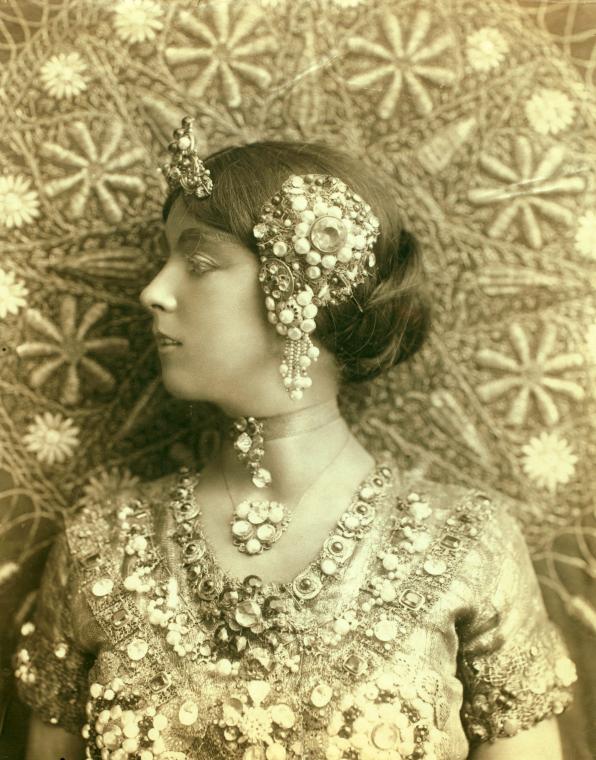
Ruth St. Denis, New York Public Library
Have you ever wondered how you can be more creative? Ever watched another dancer's amazing performance or choreography and wondered, "How can I do that?" Or, if you're like me, have you ever tried to choreograph something new, or improv to a song that felt really inspiring when you started, but now feels like an un-rhythmical mess? You've probably told yourself that you just aren't that creative, or maybe you're not cut out for performing, but in fact, there is a way you can help your creativity along.

There are a lot of suggestions from other creatives on how to get past your "dancer's block." Find an inspiring piece of music, watch other dancers, try a new style of dance, record yourself dancing over and over until you find what works--there are plenty of things you can do to spark your creativity. But one of the best things you can do is to limit yourself, rather than trying to step outside the box.

Psychological studies have shown that when people are given limits and obstacles, their imaginations soar. Our everyday lives are all about maximizing efficiency, and eventually we just try to find the easiest route (remember those one-class wonders who are professionals after one session?). However, when your brain is forced to operate within certain constraints, you are forced to come up with new ways to be original. Just look at ballet: a dance that has been around for more than a century, has strict rules on methods of movement, costuming, and music, and yet it's still one of the most beautiful art forms. Even instructors of modern dance, with all of its outside-the-box style, recommend that students study ballet first.

So how do you apply this to your own dance practice? Drill, baby, drill! Practice the basics, over and over, and then see what you can do with them. It's how the greatest fusions are born. Dancers started out in jazz or flamenco or ballet, started studying bellydance, and fused the two together because they knew the constraints of each dance and were able to take them to greater heights. But even if you're just sticking to bellydance, put on some music and practice the moves that form the foundation of bellydance. You're never too old to pretend to be a beginner. Or, if you're a little tired of drilling, find a difficult choreography and work on mastering it for a performance.

As for me, I'm going to start taking ballet next year. I've always loved it, and after going back and forth on different dances to try, I've chosen to stick with the classics. Of course, it is also the easiest class for me to get to--I don't want to make my obstacle too big!

So if you want to get more creative, give yourself an obstacle or limitation. Try to master a basic move you've had trouble with in the past, start taking a new dance style in addition to the one you have, or learn a new choreography. You'll not only get better at your new skill, but you'll also find your imagination expanding!

 Source: Need to Create? Get a Constraint

Monday, September 12, 2011

Dress Rehearsals, and Why You Need Them

I had a purple drawstring skirt that I was dying to wear to a performance. However, I'd bought it from another dancer who was slightly taller than me, so it was a few inches too long. No matter; I'll just roll it a few times and pin my scarves to it to keep it up, I told myself. But when it came time to go on stage, I realized that all the safety pins in the world weren't going to keep that heavy skirt around my waist, hip scarves or no hip scarves. For the entirety of the performance, I was in fear of stepping on that skirt and accidentally ripping it off.


What would have helped me realize that nothing short of superglue was going to keep that skirt on was a dress rehearsal. My troupe does do rehearsals, but we never do a full dress rehearsal, with everyone in their costumes and makeup, leaving it up to the dancer to determine whether or not her costume will fit. Looking back, it sure would have been helpful to try dancing in that skirt beforehand so I could realize that it wasn't going to work. I've run into many other dancers who should have tested their costumes before a performance--there's nothing more distracting than watching a belly dancer frantically tugging at her hip scarf while in the middle of a performance.


So what is a dress rehearsal, and how does it differ from just a rehearsal? Well, it's in the name already. A dress rehearsal implies that you wear your full costume and makeup and run through the entire performance, rather than just marking it out on stage. All kinds of performance art use a dress rehearsal, from theater to musicals to a ballet show. You are basically putting on the show for an empty theater before you perform the show live, allowing you and your troupe to work out any and all kinks before letting the audience in. And a dress rehearsal will point out all kinds of things that you never thought you'd have to worry about.


For instance, I spoke to a belly dance recently who was growing her hair out. Prior to an upcoming show, she decided to do some floor work, and during the dress rehearsal she went through her routine. It was during her routine that she realized the floor work wouldn't be practical because she kept sitting on her hair! She would have never thought of this before the dress rehearsal, but it was lucky she realized it prior to going on stage, or she would have had to do some quick thinking.

If I had had a dress rehearsal, or even just worn the skirt to our practice, I'd have realized beforehand that the skirt needed shortening before I could consider wearing it on stage. A dress rehearsal is also a good time to figure out if any parts of your costume need reinforcement, such as hair pieces and bra straps. The last thing you want is for a large flower to come flying off your head and hit an audience member, or for your coin bra to snap open in the middle of your show.

Even with all the preparation of a dress rehearsal, though, there are still small things you won't get to practice. I have seen plenty of zill-related incidents that would have never been worked out in a dress rehearsal. There's also the freak accidents that occur, such as a troopmate getting too close to you and accidentally hooking their costume on yours, or getting your hair caught in their jewelry. You're certainly not going to spend your dress rehearsal brushing past you troopmates to determine whether or not you'll get stuck to them! And you can't always plan for your performance space or audience, either.  Things just happen sometimes, and no matter what, you can't have control over them.

However, the advantage of a dress rehearsal is that you can be as prepared as possible. Freak accidents will happen; but that's no excuse for making sure your costume will stay put and you won't accidentally kill an audience member with a flying accessory. And one of the best things about dress rehearsal is that it gives you another chance to dress up in your finest and dance. Sometimes that ten minutes on stage just isn't enough to make up for the two hours it took to get ready, and you'll enjoy that second chance to rock your costume, even if it's just for your troupe mates.

Saturday, August 13, 2011

The Dancer

I just finished watching The Dancer, a documentary following Swedish ballet dancer Katja Bjorner as she trains to become a professional ballerina. Apart from yet another confirmation that most people don't know how to film dance, the documentary was very interesting and informative.

Dance is something that can sometimes look effortless, and most non-dancers have absolutely no idea what dancers have to go through in order to achieve that level of skill. There were a lot of scenes of Katje at the barre, going through simple ballet exercises. One of my favorite scenes was one where Katja was doing a combination of steps, and her teacher kept making her do it over and over, with changes to her hands and feet and the way she turned each time. To my eyes, I saw no difference in the way Katja was dancing, but it was clear from the teacher's tone of voice that every time, she did it a little bit better.

There was also an interesting scene where they showed Katje's pointe shoe fitting, as well as what goes into making a pointe shoe. I'm a little obsessed with feet, so these scenes were gold to me. The foot strength of ballet dancers is absolutely mesmerizing. I loved watching them go up on pointe, come down again, curl their feet to stretch them, spin around--even watching them go on pointe barefoot was amazing. And for all the stories about how ugly a dancer's feet look, I saw nary a bad foot in this documentary.

One of the things I enjoyed most, though, was listening to Katje and the choreographers talk about how to present a dance. I notice that in belly dance, you don't hear too much about the acting and theater part of it, but the reality is, you're interpreting music and a story for your audience. The joke among my fellow dancers is that the photographer always catches you making a weird face, and lucky for me, my default performance face is a great big smile, but what I really want to learn the theater aspect of it, too. There is acting going on during a dance.

The documentary showed a prima ballerina practicing with her partner, and her expressions and even the way she held herself were beautiful. It was clear what she was expressing, and for a performance art that has no words to tell the story, it was most effective. I've missed some of the workshops on theater and belly dance because I've told myself I don't really need them, but now I regret it, and I hope to find another one again soon.