So, you've found yourself teaching your first belly dance class, congratulations! Teaching baby belly dancers how to do basic moves and watching as they grasp how to circle their hips or handle a veil is so rewarding. But after the first few weeks or months almost everyone has usually grasped the basics and are looking to you to provide more. But your new students aren't ready for a performance yet, nor are they ready for an advanced class. What do you teach them now?
They might not be ready for a performance yet, but that doesn't mean they shouldn't learn a choreography! Getting used to remembering a long string of moves will be helpful later, as well as give them an early shot at learning how to combine all those moves together in a 3-6 minute sequence. Plus, you'll be ready for a performance at a moment's notice, once they've got a good choreography under their belt.
But once you've got that first choreo down, then what? Do you just keep rehearsing it? No! Teach them another one. So they're still not ready for a performance? No matter, there's a huge benefit in having a group of dancers that all know a couple of the same choreos. Why is that?
Well, if you have a couple of go-to choreos, you will always have dancers that can perform it. You'll always be ready for student performances, and you'll give new bellydance students something to aspire to. A new bellydancer will see dancers in the classes above her performing these dances beautifully, and she'll want to work for the day when she can perform with them. Also, you have a crop of dancers who can help out the baby dancers and practice with them outside of class--you have a built in team!
And if you're introducing a new choreo, you can spend entire classes working on combos or breaking down skills needed for a specific move. Class planning at its easiest!
Also, you'll be following in the footsteps of many a professional dance company. Several dance companies are known for the dances they put on year after year, and the choreography that goes with them. They don't change it up very often--why should you? Don't be afraid to tweak it every so often, if you don't like a part or you just notice your dancers having a hard time with sections, but there's no reason to throw out all your hard work and start afresh. If you want something new, just add it to your repertoire!
My very first dance teacher had 4 or 5 choreos that she taught beginning students. I recently saw a video of her latest students doing a performance--they were still doing the same choreos I learned in her beginning class, but each dancer added her own personality to it. If you stick to a set of core choreographies, you won't ever look like the same tired old troupe. There's always new dancers, new costumes, new blocking, and new venues.
In short, having a set of choreographies is only beneficial to you and your students. You'll have an easier time planning classes, your students have something to work towards, even if it's not a performance, and you'll always be ready for a show. You can't beat it!
Showing posts with label beginners. Show all posts
Showing posts with label beginners. Show all posts
Thursday, October 4, 2012
Tuesday, August 21, 2012
Comparitis
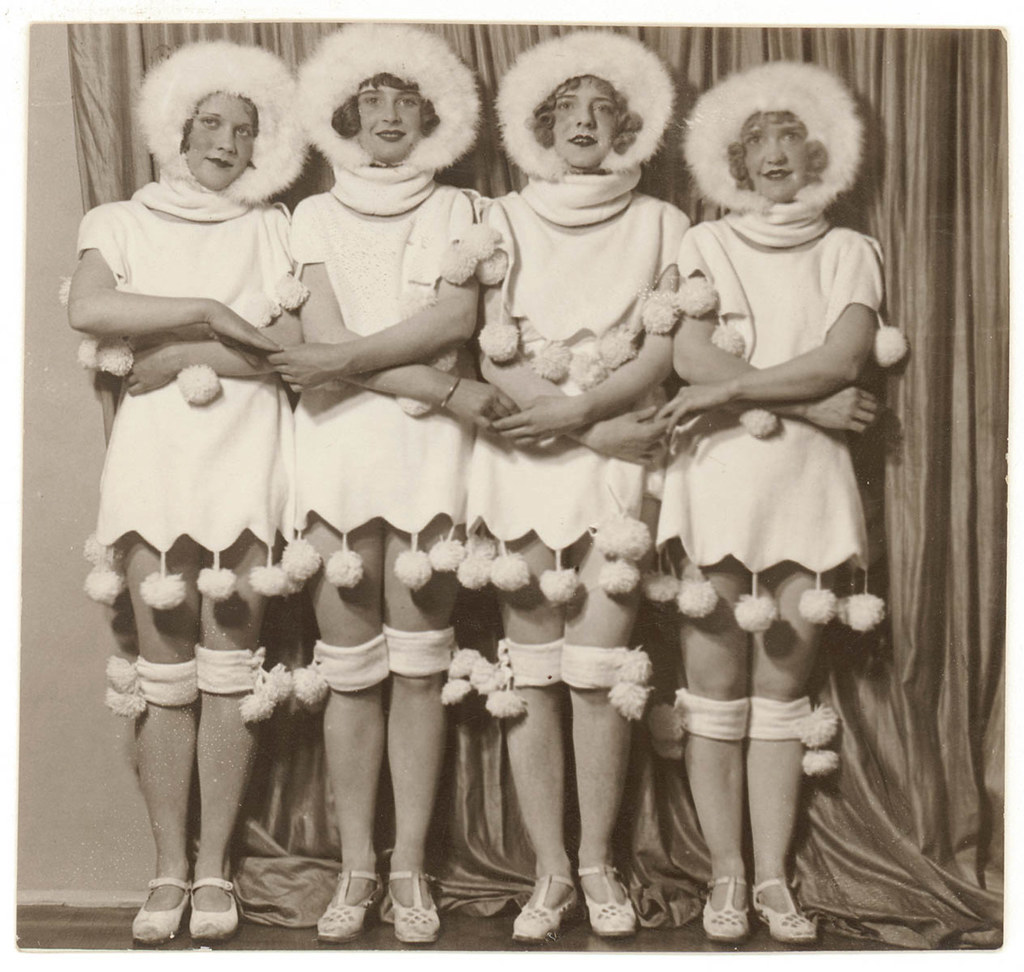 |
| Chorus Girls, State Library of New South Wales |
Comparitis.
Comparitis is comparing yourself to any other dancer. It doesn't matter if she's younger than you, been dancing longer than you, or does a completely different style then you, you'll ultimately end up comparing yourself to another dancer at more than one point in your dance career. You'll see her on the stage or in a video, and think, "Why bother? I'll never be as good as her."
I nearly caught Comparitis last week. I've been practicing with Rachel Brice's new online studio, Datura Online (check it out--classes for every dancer!), and as I tried and failed at the combination that Rachel (of course) made look like a child could do, I started to get that feeling again. For me, it starts as a sweaty, panicky feeling. Then the worry starts in the back of my mind: "What if I'm not good enough? What if I never get this?"
Luckily, Rachel had already taken to Twitter to help other dancers beat Comparitis. After someone mentioned difficulty learning a combo from one of Datura's new videos, Rachel replied that it had taken her days to memorize and learn the combo, even though she was the one who created it!
When you find yourself coming down with Comparitis, take the following remedies to hold it off--maybe even make you immune forever!
1. Remember that every dancer, including the one you are comparing yourself to, started out somewhere.
2. Every dancer is unique, especially you. You have different bodies, different background, may have done different types of dancing, had different teachers--the list goes on. No dancer takes the exact same path as you.
3. Realize that the dancer you're comparing yourself not only had to come up with what she's doing, but she had to practice it, drill it, do it until she could do it in her sleep. You're seeing the end result of months and years of hard work.
4. You're comparing your insides to someone else's outsides. The dancer you're comparing yourself to has probably looked at another dancer and said the same thing: "I'll never be as good as her."
5. Keep practicing!
After working with the new Rachel combo for 30 minutes, I was confident enough with it to think about adding it to a performance I'm doing next month. But first, I'll have to practice it a couple times!
Tuesday, April 24, 2012
I'm Just Not Creative!
|
| Chorus Girls, 192-; New South Wales Collection |
Ever think you're one of those people who just can't be creative? Do you listen to a song and think you could come up with the best moves to do with it, but when you try dancing to it, you can't remember any of it? Do you see other dancers' beautifully handmade costumes and wonder if you could ever make those costumes yourself? Or have you ever seen a really great stage show and thought to yourself "Where did they learn to do that? I could never be that creative!"
While just getting on a stage and dancing in public is difficult enough, really getting good at putting on a show might seem like an impossible skill. And it is hard: there's the music you have to pick, the costumes you have to put together, the choreography to come up with, your makeup and hair to do. Doesn't it ever feel like some of this stuff just comes naturally to other dancers? Don't you ever wonder if there's a secret to being creative?
Well, there is, and it's very simple: Practice.
Just do it!
The secret to getting better at being creative is to practice at being creative. You've going to have to work at it. Dance every chance you get, perform every chance you get. Put on music and try to make up something to go with it, even if it's just a 24-count section. If you're worried about someone seeing your attempts, lock yourself in your room or studio. You might feel uncoordinated or silly, but do it anyway.
If it's costuming you're having trouble with, just start pulling all your bellydance costuming out of the closet. Or, pick another dancer's costume and try to put together something similar using just the items in your closet. Just because you're not going to wear it on stage doesn't mean it's wasted time. You can even put the costume on and parade around the house in it, maybe film yourself dancing it a few times.
But I've tried to and I'm just not any good!
Have you really, though? Have you tried making up choreography or improv to a song? Have you done more than one performance? Have you tried dancing for your friends to see what they think? Have you gone out in public in that costume? You're better than you realize, but when you look at yourself through your own eyes, it's hard to see yourself as a great dancer.
Another thing that will help is to practice with friends. Put together a choreography workshop where you and your friends can work on individual pieces. It really helps to get feedback on your work sometimes, and you'll find that you're not as bad as you think you are. With your costume, get your friends together and do a costume swap. Throw everyone's things in the middle and start pulling pieces out and put costumes together.
Keep it simple
If you're still having trouble coming up with choreography or costumes, just narrow it down. Find a piece of music you like, and challenge yourself to use the same three moves. See what you can do with it. Record yourself if you can, and see what you can come up with during that time. Or, if you already know a choreography from class, just do the same choreo to the same music, and change the emotion. Do it sad, or romantic, or angry, and watch how the emotion completely changes the pieces.
With a costume, put together a 'dance uniform' and just add one or two things to it to make it different each time. Start with a basic skirt and bra, then change up the jewelry or belt, or do something different with your hair. Play around with your accessories.
Record, record, record
While you're playing around with choreography and costuming, make sure you keep a record of all the things you do. Pick up a cheap video camera, or record yourself on your phone. Take pictures of your costumes, either while you're wearing them or laid out somewhere. Keep them somewhere on your computer, and date them, so you can go back and watch yourself progress.
Before you know it, you'll have become much better at being a creative dancer, and you'll wonder how on earth you ever thought you couldn't do it!
Monday, October 3, 2011
To the beginning bellydancer...
Congratulations! You've just discovered bellydancing, and with it, a lifelong passion filled with fun, creativity, and great friends.
If you're just looking around at what bellydance has to offer, and haven't taken your first class yet, get yourself to one! There are many resources online that can point you to a teacher near you. Don't be afraid of sampling teachers and styles until you find one that's just right for you.
If you've started taking classes, fantastic! You've already experienced some of the wonderful aspects of bellydancing, and have hopefully met some great sisters and brothers, as well as a great teacher who can guide you through your training and help you develop your love for dance.
If you're still a little curious, here are few things bellydance is:
 -A fun hobby
-A career
-Aerobic exercise
-Social interaction
-Costume design
-Musical training
-Team-building
-Production training
-Educational
And here are a few things bellydance is not:
-Easy
-A quick way to slim down
-Stripping
-Burlesque
-Fast track to making money
Of course, if you want any of the things that bellydance isn't, there's a whole host of other hobbies and activities that can provide those things for you. However, if you've read the list and find you want more of the things bellydance is, then put on your hip scarf and get ready to shimmy!
Friday, September 23, 2011
Making the jump to teaching
I'm not a big people person by nature, so it took awhile for me to get used to the fact that I was standing at the front of the class, talking, instead of standing in the back of the room, listening, but my students are friendly and willing to learn. The studio owner, who has a decade or two worth of experience, has been fantastic about giving me advice on things to try, and while I'm stumbling along, I'm doing the best I can.
Truth be told, I had thought about contacting her and setting up classes, but I kept telling myself I wasn't ready yet, I've only been dancing for four and a half years, I have so much more to learn...so many excuses. A lot of them are the same for why I haven't performed solo.
I'm still not ready, but I'm never going to be ready if I don't start, and make mistakes, and test things. For instance, if the studio director tells me to try something new, or helps me figure out my students' personalities, I will try it next class, tweak it, see how it works, and go from there. This week, I'm putting together a simple choreo for the baby dancers to learn, so they have something to work towards.
And I've learned that not everyone dances like me. Not every belly dancer wants to be a professional dancer. Some of them just want something fun to do after work, or some reason to get away from the kids. I think that's the most difficult part, is getting into that mindset. They don't care about whether their arms are perfect; they just want to have fun dancing around to great music, and maybe show off their skills a little later.
So what have I learned so far?
Listen to your students. You can tell by their smiles, by how willing they are to work on the material you give them, how they leave the class, and how friendly they are with you, whether or not they are enjoying the class. It's this way that I can see whether or not we should move on, change the move, or keep working on it.
Know your audience. What kind of students do you have? Are they serious students who have dreams of performing and teaching one day, or just students who want a new, fun hobby? Ask your new students what their goals are, and teach accordingly.
Plan not to plan. Just like you, your students have varying moods. Maybe they've had a long week, or something happened at work or in their family. Or maybe they just aren't going to understand a move or are injured. If you plan out your class to the last detail, something will always go wrong and you'll be off your schedule. The most I will do is have an idea of what I want to teach in class, and then go from there.
Know your anatomy. The best teachers I've had know how the body works, and can explain which muscles I'm supposed to be using and when. This is probably one of the hardest parts for me, because I know all the basic moves instinctively. I can't remember what it's like to be a beginner, and not know how to do a chest lift, or what part of my abdominal I need to contract to do a hip circle. The ability to break down the move is a must for any teacher.
I hope to add more information here as I learn it--my journey into teaching is definitely a fun ride!
Subscribe to:
Posts (Atom)